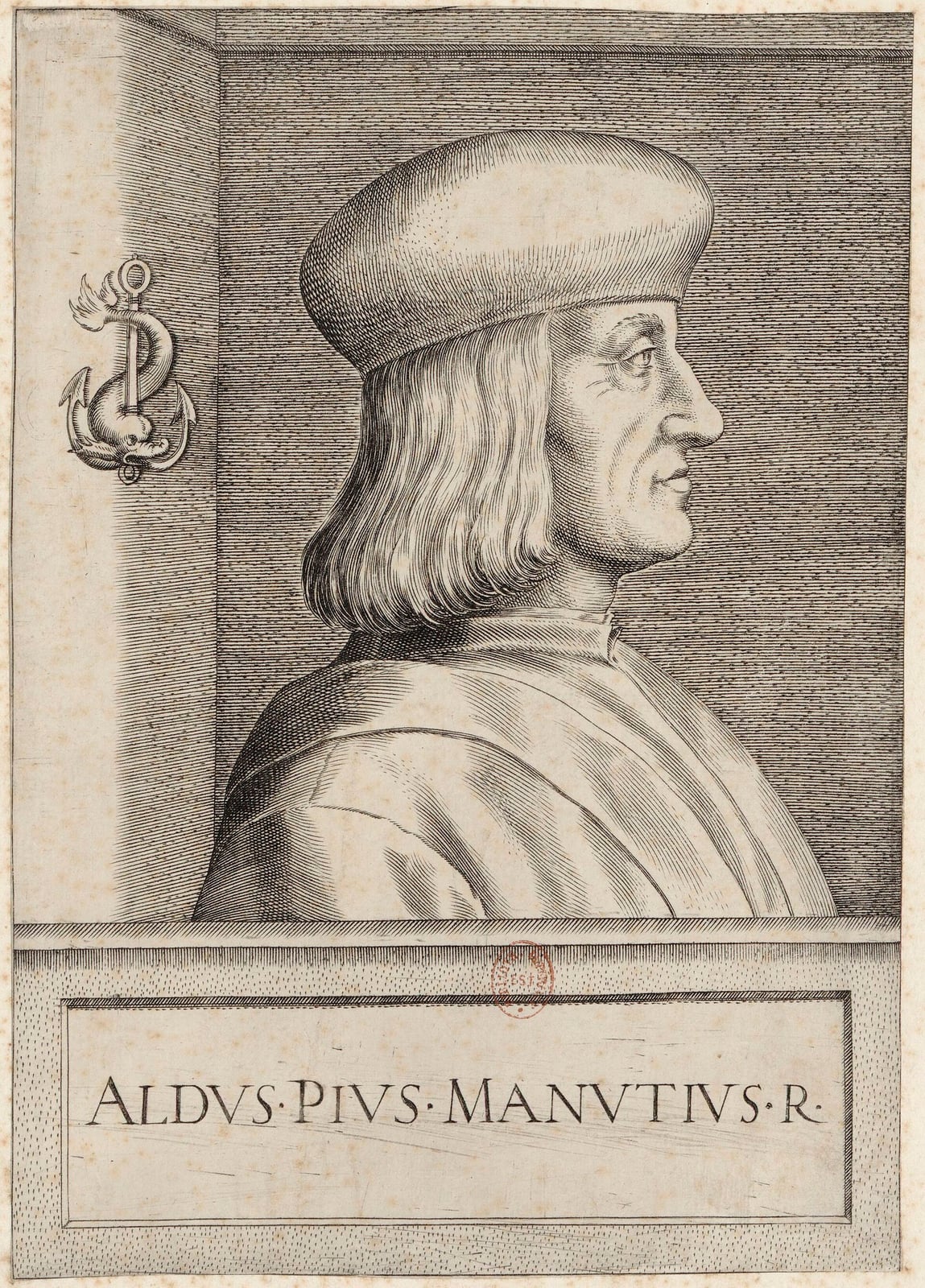
Aldus Manutius Prints Pocket Books in Italic Type
His small editions of the classics made books portable for readers on the move.
In 1501, the Venetian publishing house founded by Aldus Manutius released an octavo edition of Virgil that altered the physical character of European books. Before this departure, academic volumes were typically large, heavy folios and quartos, often surrounded by expansive apparatuses of commentary that tethered readers to stationary desks or library lecterns. By turning instead to the compact octavo format, which usually measured around five by eight or four by six inches, Manutius produced straightforward texts without distracting notes, creating small pocket volumes he referred to as libelli portatiles in formam enchiridii. These volumes offered readers an unprecedented degree of physical mobility, prefiguring modern portable formats.
The technological linchpin of these pocket editions was a slanting typeface commissioned by Manutius and designed by the Bolognese punchcutter Francesco Griffo. Modeled on contemporary humanist handwriting rather than the rigid, formal scripts typical of medieval manuscripts, this typeface became the earliest known form of italic type. Griffo's design allowed more characters to sit legibly across each trimmed line, saving paper while keeping the small pages easy to read. In the initial 1501 Virgil, the font was employed throughout the text, though without matching capital letters. Manutius obtained legal protections from Venetian authorities for his typography and format, and ran unusually large printings for the period.

Keep reading in Yester
Coming soon to the App Store
Keep following the story

Sources
Image: Rota, Martinus Sibenicensis (1520?-1583). Graveur