English Longbowmen Win at Agincourt
A smaller English army defeated French knights in the mud.
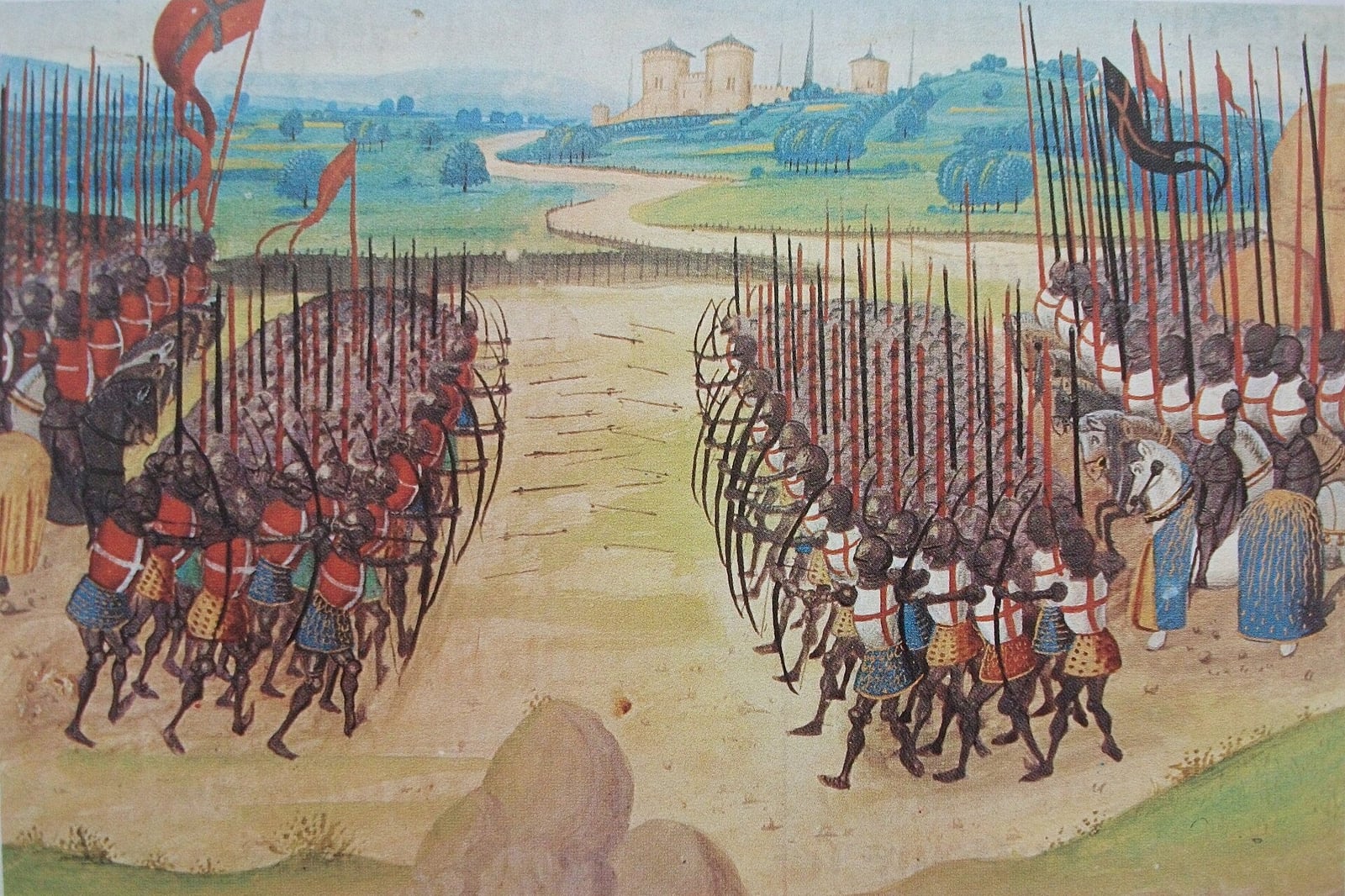
On 25 October 1415, King Henry V of England led an exhausted army into combat near the northern French village of Azincourt. English forces had captured Harfleur earlier that autumn after an extended siege, but the operation left their ranks severely depleted by dysentery and other illnesses. Aiming to reach the English stronghold at Calais to embark for home, Henry undertook a long march north, made longer when he was forced far inland to find a crossing of the Somme. French commanders shadowed the column and ultimately barred the route northward with a formidable, newly assembled host, forcing a confrontation on open ground after heavy autumn rainfall had saturated the surrounding fields.
The physical setting proved decisive. Henry deployed his troops across a narrow corridor of recently ploughed land bordered tightly by the woods of Tramecourt and Azincourt. His force of approximately 6,000 to 9,000 men consisted predominantly of longbowmen, who made up about four-fifths of the total, supported by dismounted men-at-arms in the centre. The archers planted sharpened wooden stakes diagonally into the ground along the flanks to deflect cavalry charges. Facing them, the French army, estimated by modern historians at anywhere from about 12,000 to more than 20,000 men, arrayed thousands of heavily armoured men-at-arms into dense battle formations, placing their own archers and crossbowmen behind or to the sides of the frontline.

Keep reading in Yester
Coming soon to the App Store