Edison’s Phonograph Records a Voice
A tinfoil cylinder played back sound for the first time.
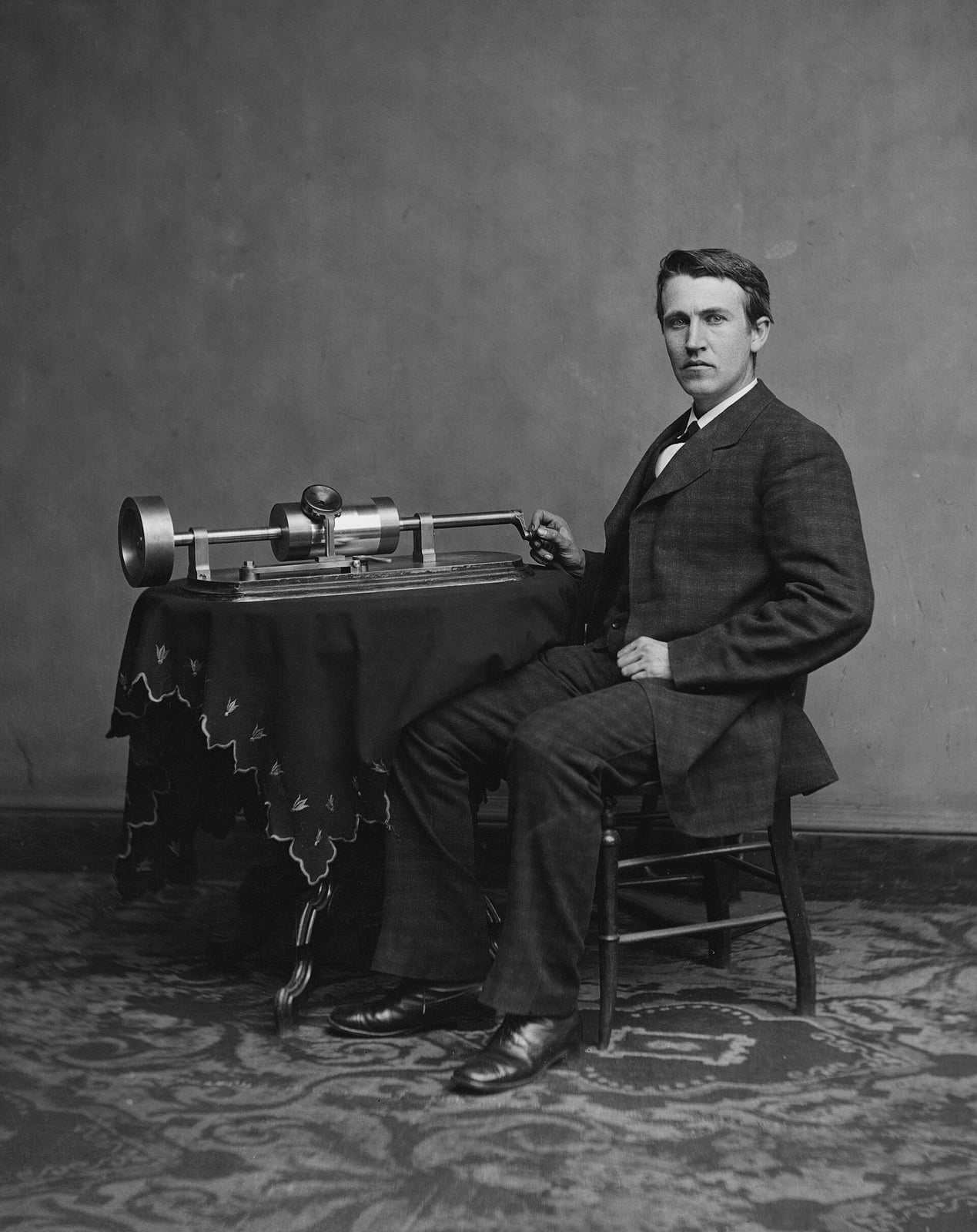
In the late autumn of 1877, American inventor Thomas Edison publicly revealed an apparatus capable of both recording and reproducing audible speech. Conceived in July of that year during investigations into automated telegraph repeaters and telephone signals, the machine captured acoustic energy by mechanical means. A letter describing the idea appeared in Scientific American in November, and machinist John Kruesi built the first working tinfoil machine during the first days of December. By December, visitors to the offices of Scientific American witnessed a small, hand-cranked device greet them directly. Patented in February 1878, the invention established a functional method for transforming transient sound into a durable physical pattern.
The initial design functioned around a metal cylinder incised with a spiral groove, mounted on a threaded spindle and covered with a thin sheet of tinfoil. When an operator spoke into the machine, airborne sound waves caused an attached diaphragm to vibrate. This movement drove a stylus against the foil, indenting microscopic variations in depth corresponding to the sound waveforms, a method termed hill-and-dale recording. To replay the track, the cylinder turned beneath the stylus, which retraced the furrow. The stylus conveyed these tactile deviations back into the diaphragm, transmitting sound waves into the room through a conical horn or directly through acoustic earphones.

Keep reading in Yester
Coming soon to the App Store
Keep following the story
Sources
- History of the Cylinder Phonograph (Library of Congress)
- Inventing Sound Recording (Thomas A. Edison Papers, Rutgers University)
- The Gramophone (Library of Congress, Emile Berliner collection)
- Researchers Play 1860 Tune Recorded Before Edison (The Day, New London, reprinting The New York Times)
- Edouard-Leon Scott de Martinville's phonautographe (Fondation Napoleon)
- Particle Physics Resurrects Alexander Graham Bell's Voice (IEEE Spectrum)
- Phonograph
Image: Levin C. Handy (per http://hdl.loc.gov/loc.pnp/cwpbh.04326 )