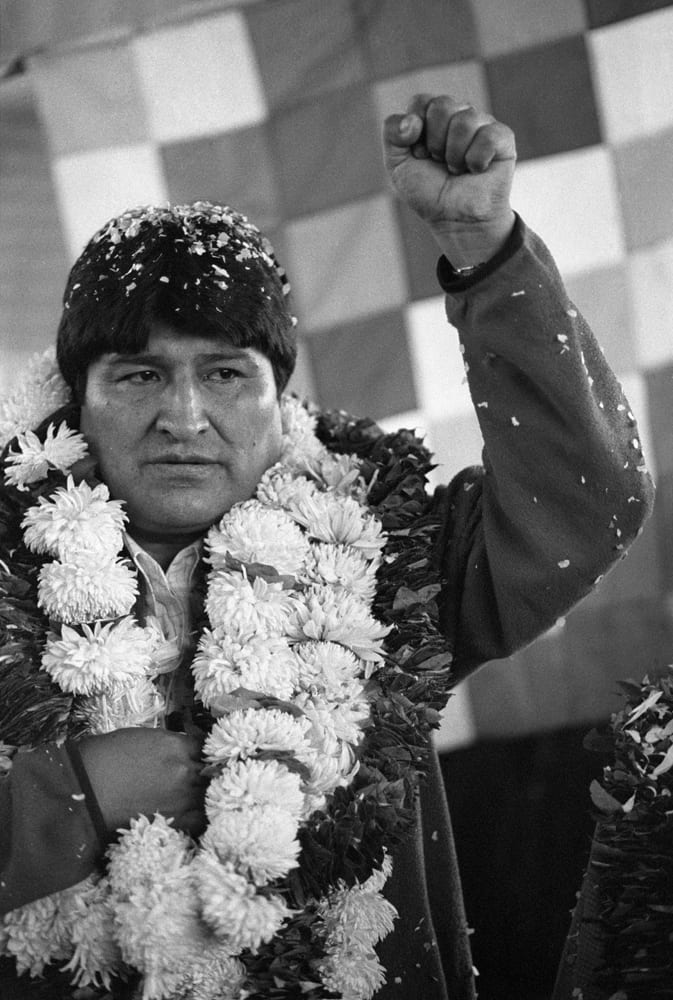
Evo Morales Becomes President of Bolivia
A former coca growers’ leader became the country’s first Indigenous president.
On 22 January 2006, Juan Evo Morales Ayma took office as president of Bolivia in La Paz. Dressed in an Andean-inspired suit rather than conventional formal attire, he addressed an audience that included several South American heads of state. Morales called for a minute of silence to remember fallen rural activists and declared that his administration would pursue a refoundation of the republic, directly likening the exclusion of the country's Indigenous majority under past political systems to apartheid in South Africa. The ceremony followed an earlier symbolic ritual at Tiwanaku, where Indigenous representatives recognized him as Apu Mallku, or Supreme Leader.
Morales was born into an Aymara family of subsistence farmers in the village of Isallawi, located in the department of Oruro. He attended school, worked various manual jobs, and completed mandatory military service before moving with his family to the Chapare lowlands in 1978. There, the household cleared land to cultivate food and coca. In the Chapare, Morales became a prominent trade unionist among the cocalero agricultural workers, opposing eradication campaigns backed by the United States that sought to destroy coca plantations to curtail cocaine production. Morales and the union movement defended coca as an ancestral Andean plant, presenting forced crop destruction as an attack on cultural sovereignty and rural survival.

Keep reading in Yester
Coming soon to the App Store
Keep following the story
Sources
- Nacionalización de hidrocarburos 'Héroes del Chaco', DS Nº 28701, 1 de mayo de 2006 (LexiVox, Bolivian legal database)
- Evo Morales: Bolivian leader's turbulent presidency (BBC News)
- How Bolivian Leader Evo Morales Cut Poverty, But Lost The People's Trust (NPR)
- 'Evo Fashion' arrives in Bolivia (BBC News)
- Evo Morales wins landslide victory in Bolivian presidential elections (The Guardian)
- Evo Morales
Image: Jorgeuzon at English Wikipedia