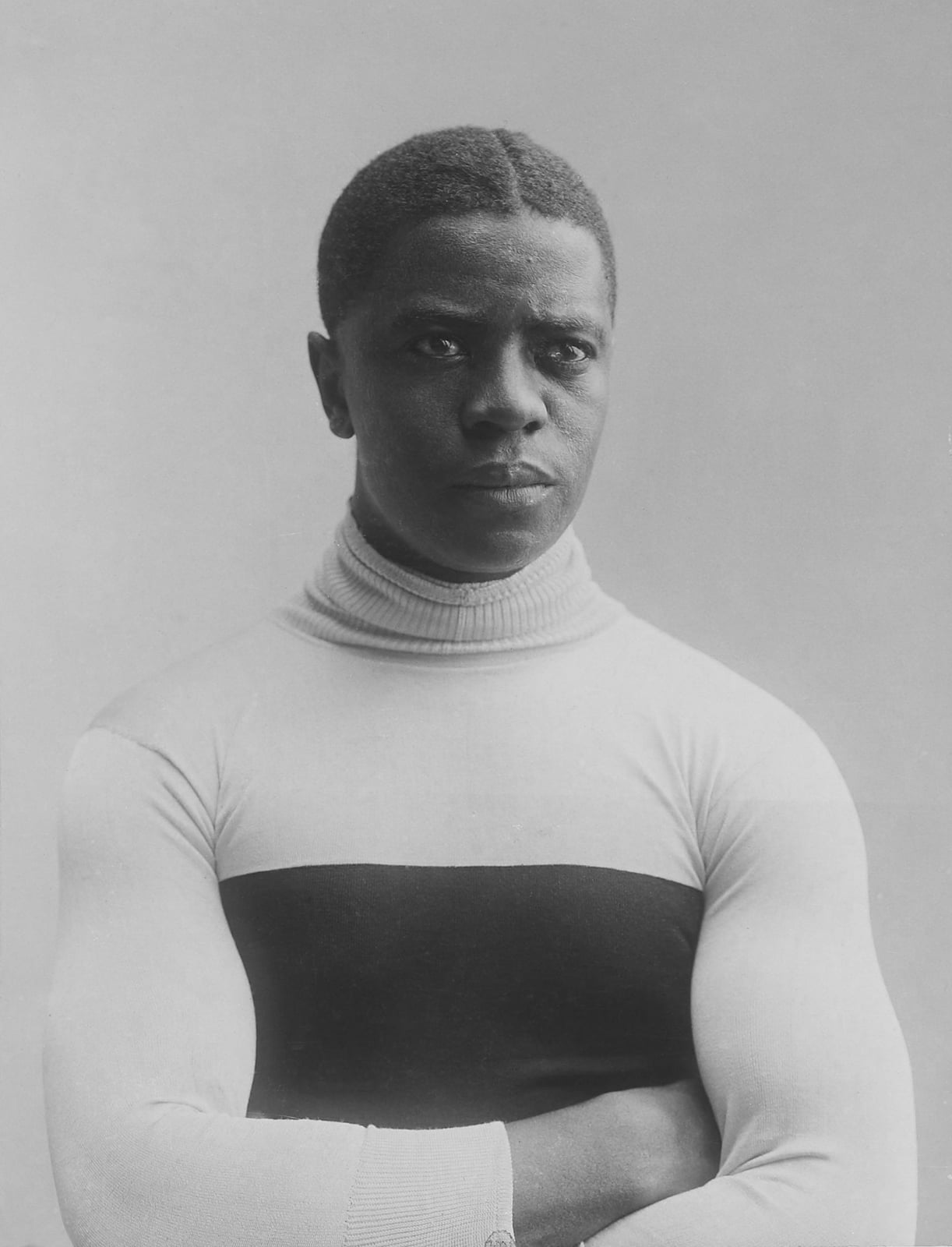
Major Taylor Races Past Barriers to a World Title
A cycling champion pursued international success while confronting segregation and exclusion.
Marshall Walter Taylor rose to international prominence during the bicycling boom of the late nineteenth century. Raised in Indianapolis, Taylor developed remarkable skill performing bicycle tricks outside a local shop while wearing a military-style uniform, which earned him the lifelong moniker Major Taylor. As a teenage amateur, he demonstrated exceptional sprinting speed, yet he faced immediate hostility on Midwestern tracks. Race organizers feared that white competitors and fans would stay away if he raced. In the fall of 1895 he moved east with his employer and mentor, bicycle manufacturer Louis Munger, who planned to open a factory in Worcester, Massachusetts, and in August 1896, after he unofficially broke a world track record in Indianapolis, he was banned from the city's Capital City track.
Establishing his base in Worcester, Taylor entered the professional ranks in late 1896 at New York's Madison Square Garden. He initially tested his stamina in a grueling six-day continuous endurance race, placing eighth, but quickly refocused his energies entirely on sprint events. By 1897, his burst of speed over distances between a quarter-mile and two miles made him one of the most prominent attractions on the national circuit. Crowds flocked to see him, yet white-dominated cycling bodies presented ongoing obstacles. Southern venues barred him entirely because of his race, and white riders frequently boxed him in on the track or committed rough fouls to thwart his progress.

Keep reading in Yester
Coming soon to the App Store
Keep following the story
Sources
- Meet Major Taylor, the Fastest Man on Two Wheels, by Peter Joffre Nye (HUMANITIES magazine, National Endowment for the Humanities)
- Major Taylor biography at a glance, by Lynne Tolman (Worcester Telegram & Gazette, via Major Taylor Association)
- INDY BEACONS: Major Taylor, the fastest man on two wheels (Indianapolis Business Journal)
- Major Taylor
Image: Jules Beau