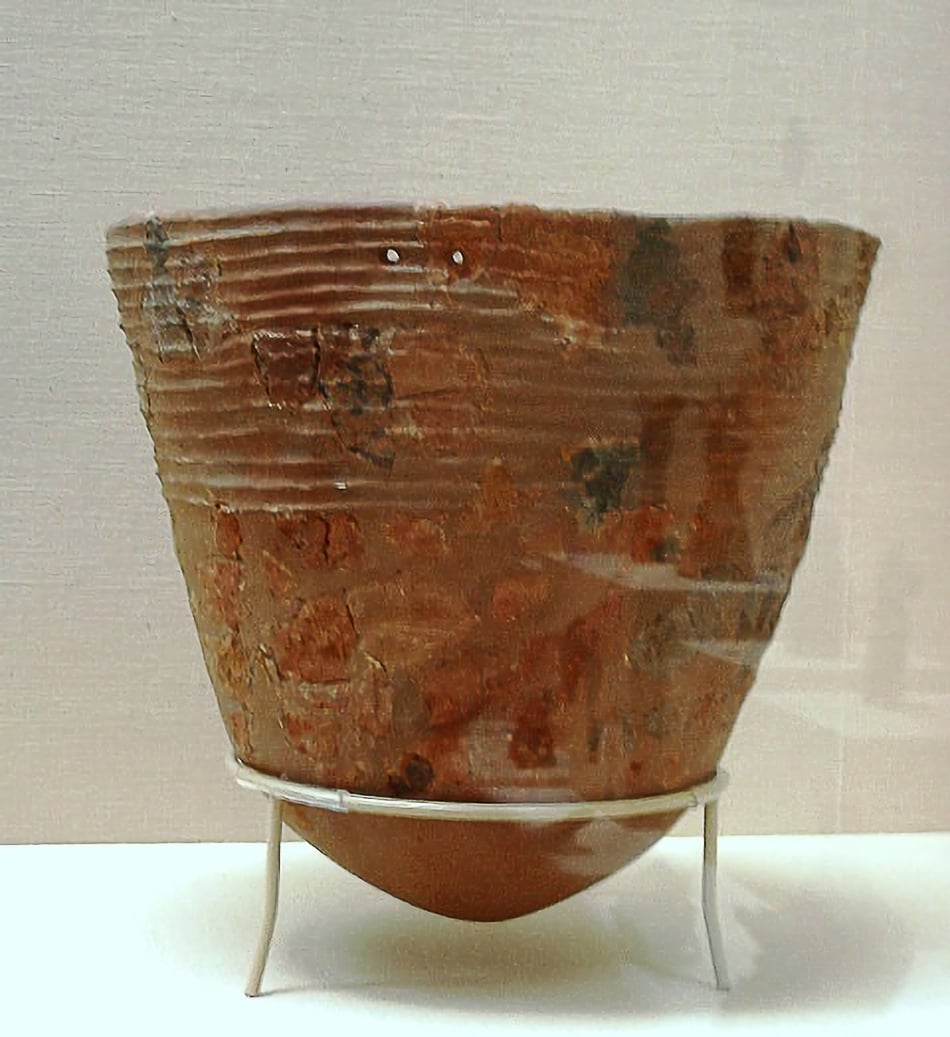
Jōmon Potters Make Some of the World’s Oldest Pottery
Hunter-gatherers in Japan were firing clay vessels about 15,000 years ago.
In 1877, the American zoologist Edward S. Morse examined ancient ceramic sherds recovered in Japan and described them as bearing a straw-rope pattern, an expression translated into Japanese as Jōmon. Following World War II, the emergence of radiocarbon dating revealed that these cord-marked wares possessed extraordinary antiquity rather than belonging to a recent prehistoric horizon. In 1998, excavations at the Odai Yamamoto I site uncovered pottery fragments that radiocarbon dating places at around 13,000 BCE, establishing that the hunter-gatherers of the Japanese archipelago were crafting some of the world's earliest known pottery.
The traditional archaeological view long held that ceramic production belonged strictly to sedentary farming communities, because bulky, fragile earthenware proved cumbersome for nomadic bands. Across the Japanese islands, however, uncommonly rich natural resources allowed foraging groups to establish semi-sedentary settlements without relying on full-scale farming. Coastal waters and sea currents provided immense quantities of shellfish and deep-water fish like salmon, while the postglacial temperate forests yielded deer, wild boar, and vast harvests of acorns and edible nuts that could be stored in underground pits.

Keep reading in Yester
Coming soon to the App Store
Keep following the story
Sources
- About the Jomon period (Jomon Prehistoric Sites in Northern Japan, official World Heritage website)
- Odai Yamamoto Site (Jomon Prehistoric Sites in Northern Japan, official World Heritage website)
- Odai Yamamoto Site (Japan Tourism Agency multilingual commentary database)
- Jomon pottery, Japan (Current World Archaeology)
- Radiocarbon dating of charred residues on the earliest pottery in Japan (Radiocarbon, Cambridge University Press)
- Jōmon period