Fossils in Morocco Date Our Species to 300,000 Years Ago
Redated bones from an old mine made them the oldest known members of Homo sapiens.
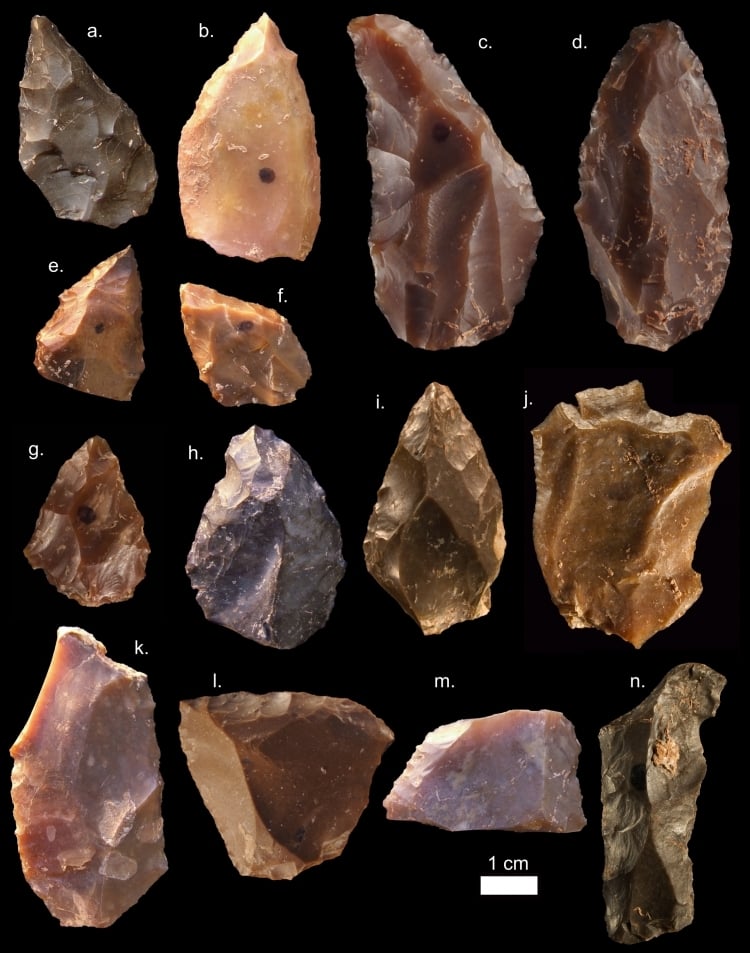
In 1961, miners extracting barite from a limestone cave at Jebel Irhoud, roughly fifty kilometers southeast of Safi, Morocco, uncovered a fossilized human skull embedded in the wall. The finding spurred an initial excavation led by anthropologist Emile Ennouchi, who had to blast away two thousand tons of overlying rubble to reach the archaeological deposits. The early investigators uncovered additional skeletal remains alongside stone implements classified as Mousterian. Because of their prominent brow ridges and the stone tool styles, researchers initially interpreted these ancient inhabitants as African Neanderthals, assuming they were roughly forty thousand years old before radiocarbon tests demonstrated the site was older than fifty thousand years.
For decades, the evolutionary position of the Jebel Irhoud material remained unsettled. Subsequent fieldwork in the late 1960s by Jacques Tixier and Roger de Bayle des Hermens established a more rigorous stratigraphic framework, discovering additional remains associated with prepared-core Levallois technologies. Morphological studies slowly undermined the Neanderthal classification, prompting anthropologists to reassess the individuals as archaic representatives of Homo sapiens or products of interbreeding. Meanwhile, the reigning paradigm in paleoanthropology placed the emergence of modern humans in East Africa around two hundred thousand years ago, supported by discoveries such as the Omo Kibish fossils in Ethiopia.

Keep reading in Yester
Coming soon to the App Store
Keep following the story
Sources
Image: Mohammed Kamal, MPI EVA Leipzig