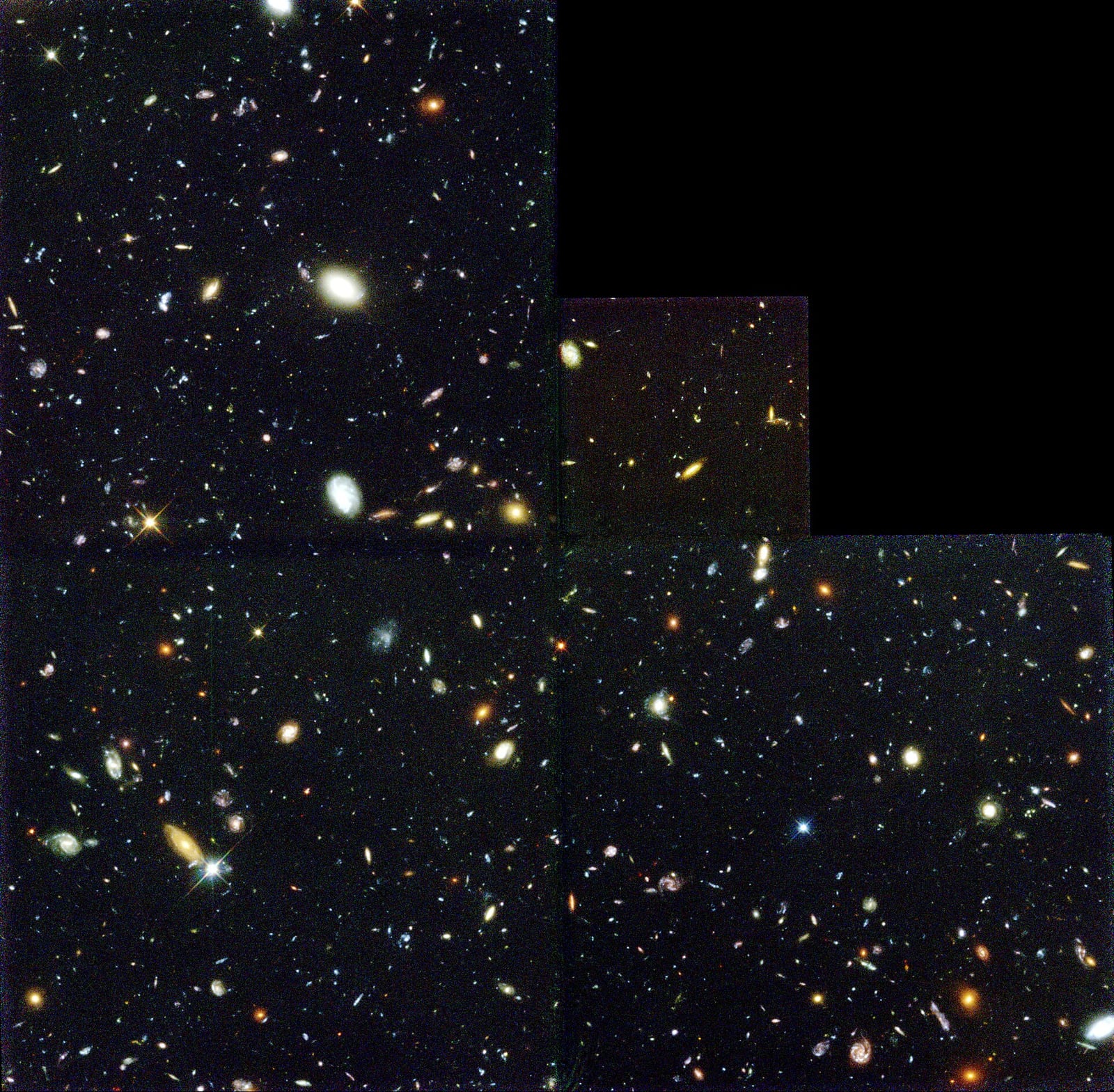
Hubble Stares into a Dark Patch of Sky
Ten days of exposures revealed thousands of distant galaxies in a tiny field.
In late December 1995, the Hubble Space Telescope focused its Wide Field and Planetary Camera 2 on a narrow, seemingly empty expanse of sky in the northern constellation Ursa Major. The target covered an area of approximately 2.6 arcminutes across, representing roughly one twenty-four-millionth of the celestial sphere. Over ten consecutive days, from December 18 to 28, the orbiting observatory completed about 150 circuits around Earth and collected 342 individual exposures. The project made use of Director's Discretionary Time allocated by Robert Williams, then the director of the Space Telescope Science Institute, who sought to devote substantial observing time to investigating early galaxy formation.
Target selection required finding a field unhindered by bright local matter. Astronomers sought an area at high galactic latitude to steer clear of the dust and obscuring material within the Milky Way disk, while also avoiding intense infrared cirrus emissions, bright foreground stars, and strong emissions across X-ray, ultraviolet, and radio bands. Furthermore, the location needed to sit within Hubble's northern continuous viewing zone, ensuring orbital visibility free from occultation by the Earth or Moon and allowing subsequent study by ground-based observatories such as Keck and the Very Large Array. The precise location was ultimately dictated by the need for an independent pair of backup guide stars, which are scarce at such high galactic latitudes.

Keep reading in Yester
Coming soon to the App Store
Keep following the story
Sources
- Hubble's Deepest View Ever of the Universe Unveils Bewildering Galaxies across Billions of Years (STScI / HubbleSite news release 1996-01)
- Hubble Deep Fields (NASA Science)
- The Hubble Deep Fields, Ferguson, Dickinson and Williams, Annual Review of Astronomy and Astrophysics (arXiv astro-ph/0004319)
- The Hubble Deep Field, Robert Williams (Space Telescope Science Institute conference paper)
- Hubble Deep Field
Image: Robert Williams ( NASA , ESA , STScI )