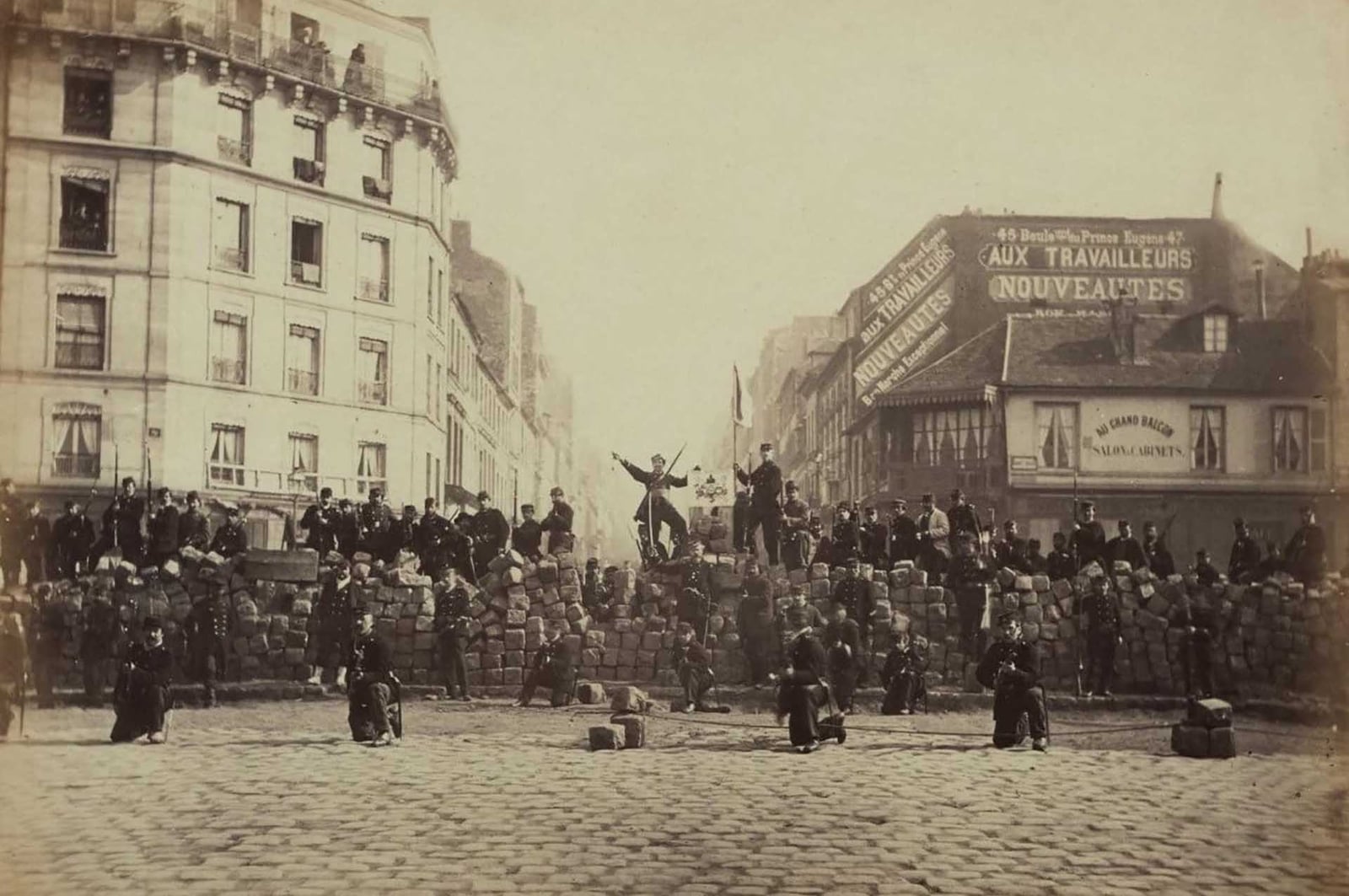
The Paris Commune Governs the Capital for Seventy-Two Days
A revolutionary city government ended in mass killing during the Bloody Week.
On 18 March 1871, regular French army units climbed the heights of Montmartre under orders from Adolphe Thiers to seize the National Guard cannons kept there in the aftermath of the Prussian siege of Paris. An indignant crowd gathered around the soldiers, and the attempt collapsed in a bloody confrontation. Two generals were captured and killed by the crowd later that day. Confronted with widespread insubordination across the capital, Thiers ordered the national government, administration, and loyal troops to evacuate Paris entirely and regroup in Versailles.
Left in control of the capital, radical factions established an independent municipal administration known as the Paris Commune, formalizing a rupture between the working-class metropolis and the conservative, rural-dominated National Assembly. The insurrectionary council was shaped by varied currents of nineteenth-century political thought, ranging from Jacobin and Blanquist radical republicans to socialists of several kinds, notably followers of Pierre-Joseph Proudhon. Over seventy-two days, this eclectic leadership issued secular and social measures, most notably decreeing the separation of church and state in early April 1871 and promoting secular schooling, though internal divisions hampered any coherent program of social reform.

Keep reading in Yester
Coming soon to the App Store
Keep following the story
Sources
- France: The Commune of Paris (Encyclopaedia Britannica)
- Commune of Paris (Encyclopaedia Britannica)
- Paris Commune: The revolt dividing France 150 years on (BBC News)
- Reassessing the Paris Commune of 1871: a response to Robert Tombs (University of Strathclyde, Strathprints)
- La Commune de Paris, ou la naissance de la laicite d'emancipation? (Nineteenth-Century French Studies)
- Life is beautiful. Life is sad (Inside Story)
- Paris Commune