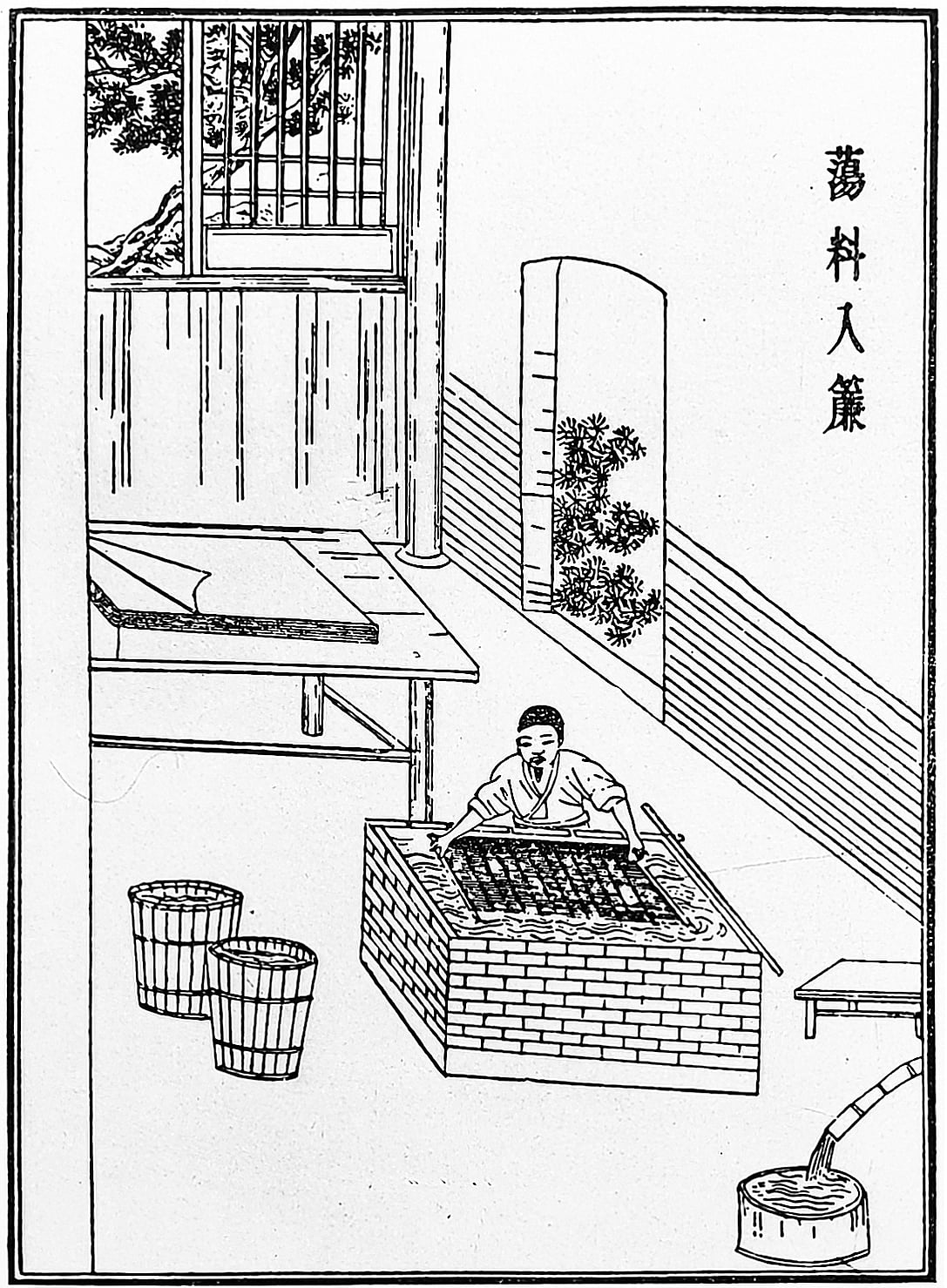
Cai Lun Presents an Improved Paper to the Emperor
A court official’s method made paper a practical writing material.
In the year 105, during the Eastern Han dynasty, the palace official Cai Lun presented a newly refined method of manufacturing paper to Emperor He at the imperial capital of Luoyang. Before this development, writing in China relied primarily on wooden and bamboo slips, which were durable but cumbersome to transport and store. Silk offered a lighter and more pliable alternative, but its high production expense prevented widespread bureaucratic and scholarly adoption. Archaeological discoveries demonstrate that crude forms of paper existed in China centuries before Cai's time, but these earlier varieties lacked the consistency and strength required for practical, everyday writing.
Cai addressed these shortcomings by formulating a novel pulp recipe and mechanical technique. His process incorporated bark from trees, discarded hemp, old rags, and worn fishnets. In the process as it is generally reconstructed, the fibers were soaked and pounded into a pulp, diluted in water, and formed into sheets on screened molds. Once drained and dried, the mixture formed sheets of uniform, resilient paper that came to be known as Cai Hou paper. This material was light, relatively inexpensive, and well suited for brushed ink, swiftly supplanting heavier wooden tablets across the imperial administration.

Keep reading in Yester
Coming soon to the App Store
Keep following the story

Sources
Image: Unknown author from the time of Ming dynasty