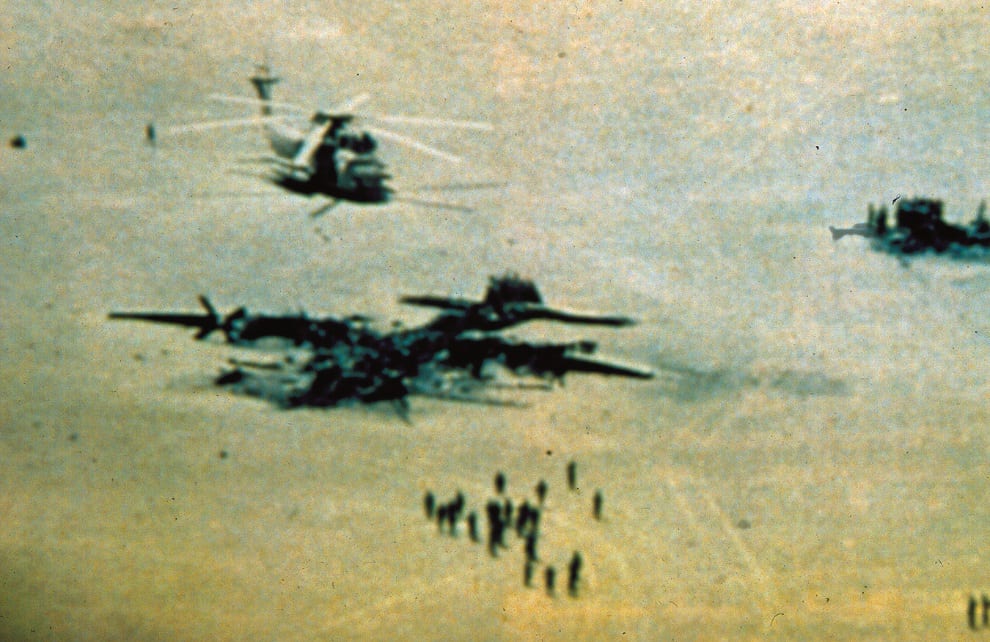
Failure of Operation Eagle Claw
A mission to rescue the American hostages in Iran ended before reaching Tehran. Its failure exposed the risks of a complex operation and prompted changes in U.S. special operations.
After militants seized the U.S. embassy in Tehran on November 4, 1979, diplomatic efforts failed to free all the hostages. President Jimmy Carter eventually approved a military rescue. Operation Eagle Claw depended on aircraft, helicopters and an assault force meeting in the Iranian desert before moving toward the capital.
The mission began on April 24, 1980. Transport aircraft reached a remote rendezvous point called Desert One, where the helicopters were supposed to refuel. The location was not as isolated as planners needed: a civilian bus and other traffic complicated the force’s efforts to remain undetected.

Keep reading in Yester
Coming soon to the App Store
Keep following the story
Sources
- Rescue Mission Report (After Action Report), FRUS 1977-1980 Vol. XI Part 1, Doc. 267 (U.S. Department of State, Office of the Historian)
- Chart Prepared in the Central Intelligence Agency, FRUS 1977-1980 Vol. XI Part 1, Doc. 266 (Office of the Historian)
- Editorial Note on the Holloway Report, FRUS 1977-1980 Vol. XI Part 1, Doc. 321 (Office of the Historian)
- Address to the Nation on the Rescue Attempt for American Hostages in Iran, April 25, 1980 (The American Presidency Project, UC Santa Barbara)
- Rescue Attempt for American Hostages in Iran: White House Statement (The American Presidency Project, UC Santa Barbara)
- Army Special Operations Aviation: The Legacy of a Disaster, ARMY magazine, January 2010 (Association of the U.S. Army)
- Operation Eagle Claw
- 1980
Image: U.S. military